Penny for the Guy: Cowling's November Fires and the Children Who Built Them
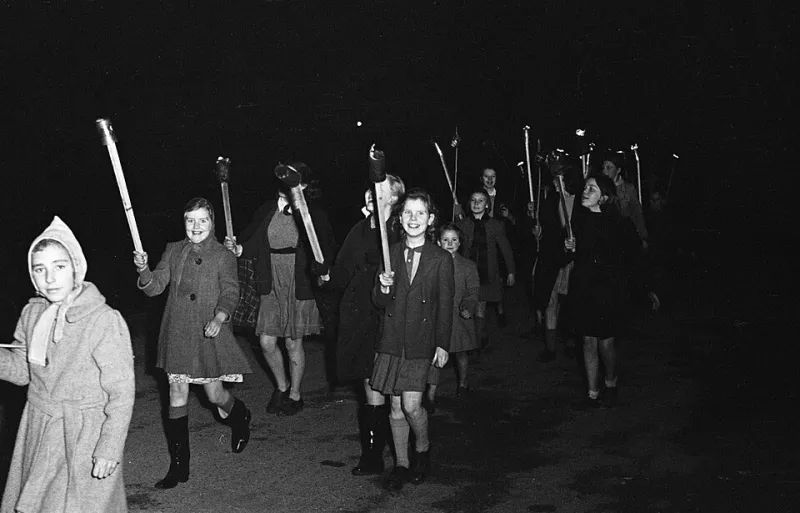
Photo: Geoff Charles, CC BY-SA 4.0, via Wikimedia Commons
November in Cowling arrives with a particular smell. Not just the damp-leaf, diesel-and-wet-wool smell of a Pennine autumn, but smoke — real smoke, carried low over the fields, catching at the back of your throat on the walk home from school. For much of the twentieth century, Bonfire Night here was not a single organised event but a scatter of small fires, each with its own cast of children, parents and patient neighbours. The village did not so much celebrate as smoulder.
Going for Wood
Ask anyone who grew up here before the 1980s and the phrase 'going for wood' will usually set them off. Children went out in the last week of October with sacks, old prams and the kind of trolley that had already survived three house moves. They came back with branches, pallets, broken fencing and anything else that looked combustible and loosely attached. Farmers were generally tolerant, provided gates were left as they were found and nothing important ended up on the fire.
The guy was the other great project. Old trousers, a jacket from the rag bag, stuffed with straw, newspaper or whatever else was to hand. The head might be a turnip, a paper mask or a pillowcase tied at the neck. Some guys were recognisable human figures. Most were closer to scarecrows that had given up. The finished article was propped outside the shop or at the end of a row, with a coal shovel for donations and a chorus of 'penny for the guy' delivered with varying degrees of enthusiasm. The money bought fireworks, sweets, or was quietly absorbed into the household purse.
Fires in Every Corner
Before the village had a formal display, the fires were everywhere. Spare ground, allotments, the edge of a field, a patch of rough hillside — if there was room for a pile of wood and a responsible adult with a bucket, there was room for a bonfire. Different ends of the village had their own gatherings, and on a clear night you could stand on the top road and count half a dozen separate smokes drifting across the valley.
The food was simple and memorable: potatoes buried in the embers, jackets blackened and split open with butter, parkin wrapped in greaseproof paper, treacle toffee that pulled at the teeth. Mothers held flasks and kept an eye on the smaller children. Fathers raked the fire and pretended not to be enjoying themselves. The bonfire was not just a spectacle. It was a place to stand and talk to neighbours you had not seen since the last one.
Mischief and Near Misses
There was an edge to it as well. Bonfire Night had its own small economy of mischief: gates moved, wheelbarrows borrowed, bangers pushed through letterboxes by children who ran faster than they had ever run before. Fireworks were let off in gardens, in tins, in jam jars, and once, memorably, from a drainpipe that did not survive the experience. Catherine wheels were nailed to shed doors and spun with a shriek that seemed to come from the wood itself.
Safety was a looser concept. Children were allowed a certain amount of danger, and most of them collected a singed coat sleeve or a small burn on the thumb as a badge of honour. The fire brigade gave advice, the newspapers reported the occasional accident, and life went on. During the war years, Bonfire Night was a quieter affair altogether, with blackout regulations and fuel rationing putting paid to any large hillside fire. After the war, the fires returned.
The Committee Takes Over
From the late 1970s and into the 1980s, the pattern began to shift. Organised displays took over, held on the recreation ground or a school field, run by a committee with a first aid kit and a collection bucket. Volunteers built the bonfire under supervision. Fireworks were bought in bulk and let off by people who knew what they were doing. The guy was still there, often judged and often laughed at, but the old scatter of private fires began to fade.
The reasons were practical rather than sentimental: access, insurance, council rules, fewer farmers with spare corners of land, and a growing sense that children should be supervised near flames. The hillside fires did not disappear in a single year. They simply became rarer, then nostalgic, then the stuff of memory.
What the Photographs Show
The photographs in the village archive tell their own story. They are not polished images. They show blurred orange light, silhouettes against smoke, children in anoraks and bobble hats, pushchairs parked at a safe distance, a lopsided guy slumped on a chair. No hi-vis jackets, no crowd barriers. Just a village making its own entertainment and standing close enough to feel the heat.
A Lasting Spark
The bonfire taught children how fire behaves. It taught neighbours to share a rake and keep an eye on each other's families. Today's display is brighter, safer and shorter, and there is nothing wrong with that. But the old fires were slower, smokier and more precarious, and they belong to Cowling too. If you have a photograph of a November fire, or a memory of a guy that never quite burned, the village archive would like to hear from you.