A Family Album Underfoot: Cowling’s Proggy Mats and the Art of Wasting Nothing
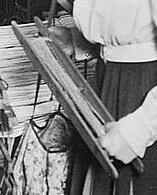
Photo: The Library of Congress, No restrictions, via Wikimedia Commons
On a wet November afternoon, with the moor lost in cloud and the flags outside the door slick with rain, there was always something to be getting on with. In Cowling’s cottages and farmhouses, that something often lay in a heap of old clothes, a square of hessian sacking and a wooden tool worn smooth by years of use. The rag rug — proggy mat, hooky rug, clippy mat, call it what you will — was the household craft that turned the winter’s indoor hours into something useful and, in its own quiet way, beautiful.
A Floor Made of Coats
Stone floors are cold. That is the first thing to remember. Before fitted carpets, before underlay and laminate and all the things we take for granted, a Cowling cottage had flags or boards, a fire in the range and a draught that found its way under the door. A rug by the bed, a mat in front of the hearth, a runner at the door: these were not decorations. They were defences.
The materials came from the family wardrobe. A coat worn thin at the elbows, trousers past mending, a dress that had seen better Sundays — none of it was thrown away until it had lived at least twice. The cloth was cut into strips, often with a pair of old shears, and sorted into piles of colour. Browns and greys were the workhorses. A scrap of red from a child’s jacket or a ribbon of blue from a blouse became a border, a flower, a sudden bit of brightness in a room that did not have much of it.
That is why the old rugs feel personal. A proggy mat was not bought from a shop; it was made from the family’s own history. A strip of father’s work trousers, a piece of mother’s coat, a square from a baby’s blanket — all of it went into the mix. A rug was a family album you walked on.
The Tools of a Thrifty Craft
The equipment was simple and mostly homemade. A square of hessian sacking, stretched tight over a wooden frame or tacked to a table, was the foundation. The tool was a prodder: a wooden handle with a metal point, sometimes called a peg or a bodger, though names varied from house to house. There was also the hook, for the hooky rugs, which pulled loops of cloth up through the hessian rather than pushing them through. The principle was the same: make a dense, warm pile out of what you had.
Men often made the frames, and sometimes the tools, but the making was usually women’s work. It was slow, sociable and easily interrupted. A neighbour would come in for a cup of tea and stay to help sort strips. Children were given the job of cutting, or of holding the hessian steady. The work could be picked up and put down between chores, which made it fit the rhythm of a household rather than fighting it.
The best mats were tight and heavy. A loose one would ruck up underfoot and wear through in a season. A good one could last for decades, and many did. If you lift the corner of an old proggy mat today, you can often still see the pencilled lines where the maker marked out her border, or the places where a strip was joined because the scrap ran out.
Wool, Sacking and the Mill’s Shadow
Cowling was a wool town, and the rag rug was a wool-town craft. The mills did not just employ the village; they dressed its floors. Offcuts, thrums and waste yarn found their way into homes, sometimes bought cheaply, sometimes passed on. Sacking came from the feed merchant or the corn store. Nothing was wasted because nothing could afford to be.
That thrift was not the same as poverty, though poverty was often nearby. It was a habit of mind. A household that had known hard times kept a rag bag as a matter of course. The rag bag was a kind of savings account: a reserve of colour and cloth that could be drawn on when the floor needed warming or a chair needed a cushion. In a place where the weather could turn a walk across the yard into a soaking, and where the mill whistle set the day, the rag rug was part of the same practical economy as the vegetable patch and the mended boot.
Patterns in the Scraps
There were no pattern books. The pattern came from the scraps themselves. A maker might decide on a border of reds, a centre of browns and greys, and a few bright diamonds or stripes to break the middle. Some rugs were almost plain, made from whatever came to hand. Others had a symmetry that must have taken careful planning, with colours saved for weeks until there was enough of a particular shade.
This is where the quiet creativity comes in. These were not women with time on their hands and nothing else to do. They were women who had worked all day and were now making something out of nothing, for a floor that would otherwise be cold. The creativity was in the arrangement, the discipline of the border, the decision to put the brightest strip where the firelight would catch it.
What the Rugs Still Tell Us
Some of these rugs survive. They turn up in families, passed down with a story attached: this one was made by Grandma, this one came from the old house, this one has a strip of a wedding dress in it. They are not grand objects. They were never meant to be. But they are documents of domestic life, and they tell us something that the ledgers and directories cannot: what people wore, what they kept, what they could not bear to throw away.
In 2026, when so much of what we own is bought and discarded without a second thought, the proggy mat feels like a lesson in slow making. It says that comfort could be made at home, that colour could come from a worn-out coat, and that a floor could carry the memory of the people who walked on it. If you have one in your family, keep it. If you do not, look closely at the next one you see. Somewhere in the pile there is a story, and it is probably wearing a familiar colour.