A Few Pence Against Bad Luck: Cowling’s Friendly Societies and the Village Safety Net
There is a particular kind of arithmetic that once mattered in Cowling. It was not the sum worked out on the back of a mill ledger or the price of a load of stone. It was the weekly count of coppers set aside for a society box: a few pence from a wage that never stretched far, paid so that illness or death would not tip a family into disaster.
Before the NHS, before the welfare state, before sick pay was something an employer might mention, Cowling’s working families often insured themselves through friendly societies, burial clubs and local sick funds. The names varied. The principle did not. You paid in while you could, and the society paid out when you could not.
It was mutual aid in its plainest form. Not charity handed down from above, but a promise made between people who knew exactly how close any household was to a bad week.
When a Bad Week Could Ruin a Family
In a village shaped by mills, farms, quarries and small trades, income could stop suddenly. A hand caught in machinery, a chest complaint that lingered through winter, a fall on wet stone, a funeral that had to be paid for before the next wage came in: any one of these could unsettle a family for months.
There was no sick pay from the mill, no ambulance to call, no universal credit to fall back on. Savings, if they existed at all, were thin. Relatives helped where they could, and neighbours did what neighbours do. But informal help could only go so far, and nobody wanted to ask too often.
Friendly societies offered something more dependable. Members paid a small subscription, usually weekly or fortnightly, and in return received a set amount during sickness, and often a payment towards a funeral. Some clubs also helped with medical costs or provided a small sum at confinement. The amounts were modest, but modest was often enough to keep the wolf from the door.
The Box, the Book and the Weekly Pledge
Friendly societies were sometimes called box clubs, because the money was kept in a locked box. In Cowling, as in towns and villages across the West Riding, branches of the larger orders were familiar names: the Oddfellows, the Foresters, the Rechabites, the Druids, the Shepherds. A local branch might be called a lodge or a court, and it had its own officers, rules and rituals.
Someone collected the subscriptions. Someone kept the book. Someone had to decide whether a member was genuinely too ill to work, and whether the rules allowed a payment. These were not faceless institutions. They were run by local people, for local people, and the account books recorded the small dramas of village life in columns of pence and shillings.
Membership was not automatic. A person had to be proposed, accepted and keep up payments. Arrears could mean losing benefit, and rules could be strict. This was self-help with a hard edge, because the money had to go round. Yet the system worked because members trusted one another, or at least trusted the book, the box and the meeting.
Meeting Rooms and Annual Walks
Friendly societies met in the places available to them: a pub back room, a chapel vestry, a schoolroom, a hired hall. Meetings combined business with sociability. There were minutes to read, accounts to pass, new members to ballot for and old members to remember. There was also, no doubt, a good deal of talk that never made the minute book.
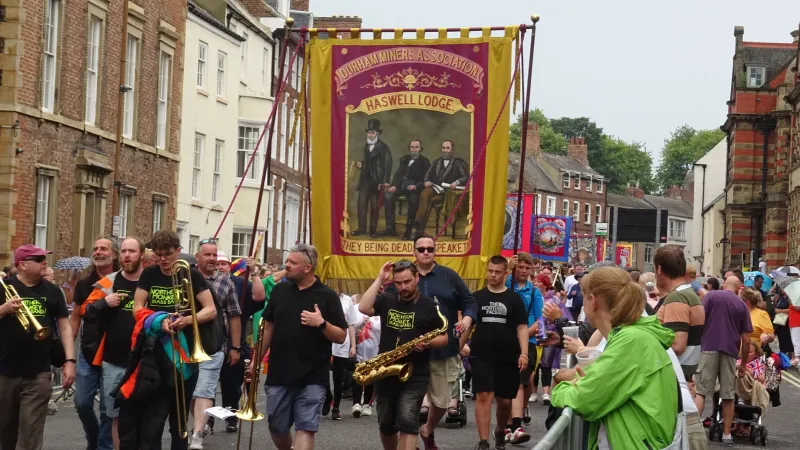
The annual walk was the public face of it all. Once a year, members turned out in their best, often with sashes, banners and a band if one could be found. They walked through the village to a service or a dinner, showing that the society was alive and that its members belonged to something. For families, it was a day out. For the society, it was a statement.
Cowling’s walks may not have matched the great processions of Keighley or Colne, but they mattered. They gave working people a place in a formal procession, a reason to polish boots and a reminder that the village looked after its own in an organised way.
The Doctor’s Club and the Burial Club
Not every arrangement was a grand friendly society. Many villages had smaller clubs: medical clubs that paid a doctor a regular sum in return for care, penny savings clubs, burial clubs run through chapels or pubs. These were often less formal, but they answered the same need.
A doctor’s club could mean the difference between calling someone out and hoping the illness passed. A burial club meant a funeral could be arranged without a frantic collection among neighbours. Women’s societies and separate women’s branches also existed, offering benefits around sickness and childbirth at a time when women’s earnings and security were especially precarious.
It would be sentimental to pretend the system was perfect. Some people could not afford the subscriptions. Some were excluded by age or health. Some clubs failed, and some members lost out. Friendly societies were a buffer, not a cure for poverty.
When the State Stepped In
The ground shifted in 1911, when the National Insurance Act brought state sickness and unemployment insurance for many workers. Friendly societies became approved societies, administering benefits within the new system. After the Second World War, the welfare state and the NHS took over much of what the clubs had once provided.
Friendly societies did not vanish overnight. Some continued as social clubs, some merged, some faded quietly. Their banners went into storage, their books into attics, and their weekly rituals into memory. The safety net had moved from the meeting room to the town hall and the hospital.
What Remains
What remains in Cowling is not a monument but a habit of mind: the knowledge that people here have long understood the value of putting something by for a rainy day, and of doing it together. If you have an old membership certificate, a small brass box, a photograph of a society walk or a relative’s name in a subscription book, you are holding a piece of that quiet history.
The penny in the box was never just money. It was a promise that bad luck would not be faced alone.