The Dog on the Lane: Cowling's Boggarts and the Tales Told After Dark
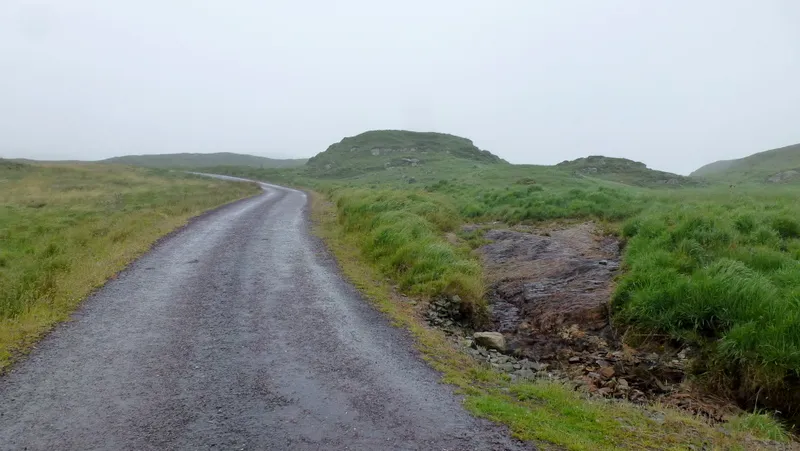
Photo: Jonathan Billinger , CC BY-SA 2.0, via Wikimedia Commons
Every black dog story in the country ends the same way. It ends with somebody saying, in a voice that wants to be reassuring, ‘It were only a dog.’
Which rather misses the point. If it were only a dog, nobody would have remembered it eighty years later.
A black dog is never just a dog
The Pennines are thick with them. The Barghest, the Gytrash, Padfoot, the Church Grim — different names for a shadow that keeps to the wall on a lane at dusk, sometimes the size of a calf, sometimes with eyes like saucers, always silent. In Cowling the stories are smaller and more domestic: a dog on the lane between farms, a dog that follows a man to a stile and no further, a dog that was seen by two people and described by both in slightly different, entirely sincere detail.
There are reasons to be sensible about this. There are sheep on that lane and sheep at dusk look enormous. There are real dogs. There is the pint. But the tellers knew all that, and told the stories anyway, and the telling is what we are interested in.
Boggarts in the barn
The boggart is the other great Yorkshire inheritance. Not a monster so much as a nuisance with a temper: the presence in the outbuildings that could not be seen but could certainly be heard. A latch lifting. A bucket moving. A noise in the shippon at the hour when no beast should be moving.
The best-loved version of the tale is the boggart that came with the family. A household moves three miles across the parish, unpacks the cart, and hears the familiar clatter from the back kitchen with a sigh of ‘Well, we've shifted thee, then.’ It is a joke as much as a ghost story, and Yorkshire has always liked its supernatural visitors to have a sense of humour.
Most farm boggarts were eventually explained, or explained away, by an owl, a loose slate, a beam that shifted in the wind. The explanation never quite killed the story.
Lights that move
Out on the tops there were lights. Some were will-o'-the-wisps over wet ground, some were a farmer with a torch out after a ewe, some were a miner's lamp or a car on a distant road. Some were the tower on the edge of the moor catching the last of the sun, and a child sent to fetch water being told to hurry up.
The older name for a moving light in these parts was a corpse candle, and it came with a rule: you did not follow it. Whatever the light turned out to be, the instruction attached to it was a practical one, and the practicality is the point.
The chapel and the dark ground
The chapel preached against all of it, of course. Superstition was to be reasoned out of the parish along with the drink and the dog fighting. And yet the tales survived — not in the pew, but in the kitchen, in the scullery, in the two minutes between the last lamp being lit and the stairs being climbed.
Beyond the last wall the moor was, by common agreement, different ground. The quarries, the tarn, the great stones with names, the field corners nobody had a reason to visit after dark. It was not that people believed the place was wicked. It was that they knew it was indifferent, and a place that does not care what happens to you is a place that needs stories.
What the tales were for
Here is the thing worth saying plainly: these stories did work.
They kept children off the tarn and away from the quarry edges, where a fall would be found too late. They kept boys out of the hay barn with a lantern. They gave a shape to the unexplained — the drowned man, the body found on the lane, the death in a snowbound farmhouse with only the family to witness it. Where there was no headstone close by, a story could stand in for one.
And they entertained. A winter fireside is a long evening, and a good teller could make three miles of wall and a stile last an hour. Stories were told, retold, and improved. A dog became larger. A light became nearer. A grandmother who never claimed to have seen anything at all became, in her grandson's version, the woman who would not walk that lane after dark for forty years.
Telling them still
Ask around Cowling and you will still find people with a story they were told, or half-told, or told not to repeat. A shape at a gate. A feeling on a particular bend. A house where the dog will not go upstairs.
We would rather hear them than argue with them. Send us the one you were told as a child, and the one you were told not to tell. We will not claim to settle whether it was only a dog.
And if you do go looking for the black dog on the lane at dusk — go with somebody, and take a torch. Not because of the dog. Because of the wall, the ruts, and the fact that the lane has always been the sort of place where people trip.