Long Shadows, Short Legs: The Summers That Built Cowling's Cricket Field
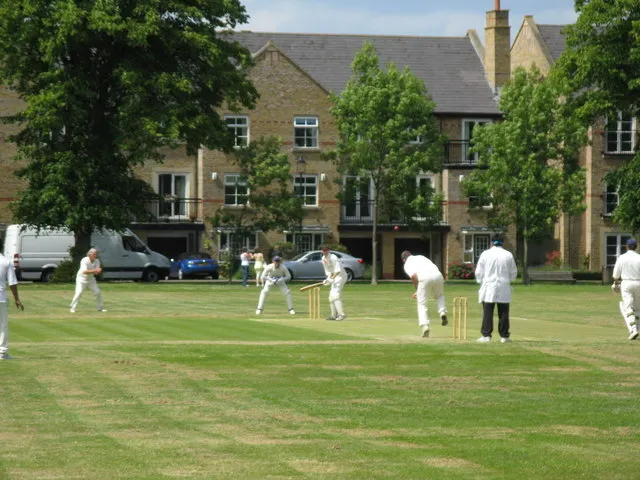
Photo: Dr Neil Clifton, CC BY-SA 2.0, via Wikimedia Commons
Somewhere in a house in Cowling there is a scorebook with a chewed corner and a Saturday in July pencilled across the top, and it probably still says what everybody said at the time: that the light was going, that the last over took half an hour to bowl, and that the lad who came in at nine did better than anyone expected.
That is how a cricket club survives — in paper, in argument, and in the memory of an afternoon nobody thought was important at the time.
A field before it was a ground
Village cricket rarely begins with a pavilion. It begins with a field that somebody was willing to lose for an afternoon, a horse to pull the roller, and a scythe to take the worst off the outfield. The square was cut short and the rest left long, which is how a ball struck firmly along the ground could vanish into the rough and be hunted for by boys paid in lemonade and instructions not to tread on the wicket.
Early wickets were matting laid over rolled earth, and there are older villagers who will tell you that a ball which misbehaved on that surface was not a bad ball but a wicked one. The first pavilion, in most versions of the story, was a shed. The second was a better shed with a kettle in it. Only much later did anybody think to call it a clubhouse.
The men with the biscuit tin
Every club has a treasurer and every treasurer has a tin, and in Cowling the tin mattered. Subscriptions were collected in person, partly because the post was unreliable and partly because collecting them was an excuse to stand in a doorway and talk about the team. The roller was borrowed. The whitewash bucket had a rota. The scorebook was bought out of somebody's own pocket and never quite claimed back.
The surnames in those books recur the way surnames do in a village — Hartley, Kershaw, Waddington, Shackleton, Whitaker, Pickles — and ask three people who was the best batsman the club ever produced and you will get four answers, all delivered with feeling and none of them short. There was the fast bowler who bowled off the wrong foot and took wickets anyway. There was the umpire who gave nobody out before four o'clock on principle, and the opening bat who would not walk even if the ball had hit the stumps and rolled to the boundary.
Teas, and the business of the long half-hour
Away teams remembered Cowling for its teas. Egg sandwiches cut thin, potted meat, tinned salmon when the money allowed, and slab cake in quantities that suggested the baker had been warned in advance. The urn was the club's most temperamental piece of equipment and the tea ladies its most reliable members, working a rota that had been running, in one form or another, longer than most of the players had been alive.
The interval between innings was never fifteen minutes. It was a slow, generous, entirely unofficial hour in which the fielding side ate too much and the batting side worried about the light. Nobody ever complained, because complaining about tea would have been worse than losing.
On the boundary
The spectators were the club's other half. Deckchairs appeared in the back of cars. Dogs were walked round the edge and then sat down firmly on the boundary rope. Children fielded at long stop out of duty and lost interest out of principle. Farmers leaned on the gate, said they had only come for ten minutes, and stayed till six.
A good crowd did not make a noise so much as a low, steady commentary: the man behind the bowler's arm explaining what the captain ought to have done, the woman with the flask offering round the last of the tea, the small boy asking, for the fifth time, when there would be cake.
Neighbours, and the fixture that mattered
League cricket gave Cowling its Saturdays, but the needle was always local. Lothersdale, Oakworth, Haworth, Cross Hills, Glusburn, Sutton — matches against these were not simply fixtures but long-running conversations conducted in runs and grudges. A midweek knockout brought out men who had retired years before and now discovered they could still bat. A friendly against a neighbouring village mattered more than any league game, though nobody would have admitted it.
Rain ruined more afternoons than any bowler. There were days when the covers were a tarpaulin, the tarpaulin leaked, and the whole ground stood about watching the square with the expression of people waiting for a bus that was never coming.
The years it nearly went quiet
The club had its lean patch. Cars took the young men down the valley to other grounds and other entertainments, and for a while the fixture list shrank to something thinner than anyone wanted to remember. What saved it was the least glamorous work: colts coaching on a weekday evening, mums and dads making sandwiches, a square re-laid, a mower that got its own shed, a bar that turned a profit.
Why the sound still carries
On a still summer evening, walking a lane above the village, you can hear bat on ball from a long way off, and it does something to people who grew up here. It is the sound of a place being ordinary and content at the same time.
There are ashes scattered at the edge of that field. There are grandfathers remembered by the way they stood at the crease. There is a bench with a name on it and a view that has not changed in a hundred years.
So if you have photographs, a fixture card, an old scorebook or a story about a catch that was definitely a six, our door is open. Cowling's cricket summers deserve better than a drawer.