Buckets Against the Sky: Cowling’s Volunteer Firefighters and the Moorland Blaze
Every village has a sound it hopes never to hear. In Cowling, for generations, it was the shout of “Fire!” carried over a wall, the clang of a handbell, or later the telephone ringing in the hallway of a man who kept his boots by the door. Long before a yellow engine could be relied upon to come up the lane, the first line of defence was the village itself — a straggling, determined line of neighbours passing buckets from the nearest well, trough or beck towards a burning barn, a smouldering mill roof or a runaway heather blaze on the moor edge.
Before the Engine: Buckets, Beaters and a Wet Sack
The earliest firefighting in Cowling was not a service but an instinct. Farmers, weavers, shopkeepers and mill hands all knew where the nearest water stood, and most households kept something that could carry it. Parish notices from the nineteenth century repeatedly reminded residents to keep a bucket in good repair and a chimney swept — the sort of advice that sounds quaint until you remember how quickly a spark in a thatch or a timber loft could take hold.
The equipment was modest and practical. Leather buckets, some stamped with a farm or chapel name; fire hooks for dragging burning thatch down to the ground; birch besoms and wet sacks for beating out flames; and, later, stirrup pumps that turned a bucket of water into a thin, hopeful jet. In the yard of a big house or the shed behind a mill, a hand-pulled or hand-pumped appliance might sit under a tarpaulin, its leather hose coiled like a sleeping animal.
Water was always the difficulty. Cowling sits high, and the lanes are steep. A bucket chain up from the beck or a well could be a hundred yards of mud and smoke, and every pair of hands mattered. Villagers still remember the rhythm of it — the swing of the arm, the slap of a full bucket against a palm, the passing of the word back down the line. It was hard, filthy, frightening work, and it depended entirely on people turning out.
The Fires That Made a Brigade
The mills changed the stakes. Textile mills were built of stone but filled with wood, oil, dust and machinery, and a small fire could become a disaster before the first bucket arrived. Mill owners began to take the matter seriously, and newspapers from the late Victorian and Edwardian years carry familiar reports: a blaze in a shed, a narrow escape, a crowd of volunteers forming a line, and a grateful note that the damage was confined.
By the early twentieth century, Cowling’s volunteers were a familiar sight at drills and village events, their names recorded in parish magazines and their annual supper reported with the same enthusiasm as a cricket match. They were not full-time firefighters. They were joiners, farmers, weavers and shopkeepers who kept a helmet on a shelf and a coat on a hook, and who knew that when the bell went they might be gone for hours.
The Second World War brought a more formal structure. The Auxiliary Fire Service and later the National Fire Service drew local men and women into organised crews, with uniforms, drills and a chain of command. After the war, county brigades and retained firefighters took over the old voluntary arrangements, but the village pattern survived: local people, trained and paid a small retaining fee, ready to leave their tea and run.
When the Moor Burned
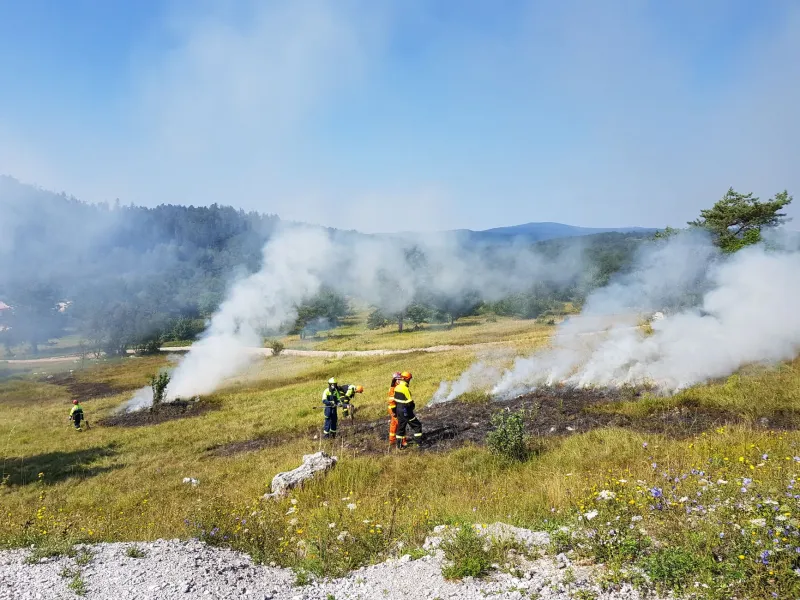
Moorland fires are a different enemy. Heather and bracken burn fast and hot, and the wind can turn a controlled heather burn into a front that runs for miles. Farmers have long used fire as a tool to manage the moor, but the old hands always watched the wind, kept a beat and never left a fire alone. The warnings were repeated in chapel and pub alike: mind the wind, keep the beat, and never assume it is out.
In the long drought of 1976 the ground above the village cracked like a plate, and in drier summers since, the smell of smoke on the breeze has brought the old instinct back. Villagers still talk about the years when the moor seemed to smoulder for weeks, and about the crews who walked up with beaters while the sun went down red over the hill.
Modern firefighting in Cowling is in the hands of North Yorkshire Fire and Rescue Service and its retained crews, with tankers, hydrants and thermal imaging. But the old lessons have not faded. A barbecue left smouldering, a discarded cigarette, a match in dry grass — these are still the beginnings of the same story. If you see smoke on the moor, ring 999, give the best location you can, and keep the lanes clear for the engine.
The Chain Still Holds
There is a quiet poetry in the old bucket chain: a village linked hand to hand, passing water against the odds. The buckets themselves now hang in barns and museums, and the handbell has gone silent. But the instinct that built the chain — the neighbour who drops everything, the farmer who knows the path, the crew who leave their Sunday dinner — is still the heart of rural firefighting.
Next time you see a retained firefighter’s car parked askew on a Cowling lane, spare a thought for the line of hands that came before. The equipment has changed. The willingness has not.