Posted From the Moor: What Cowling's Old Postcards Still Whisper
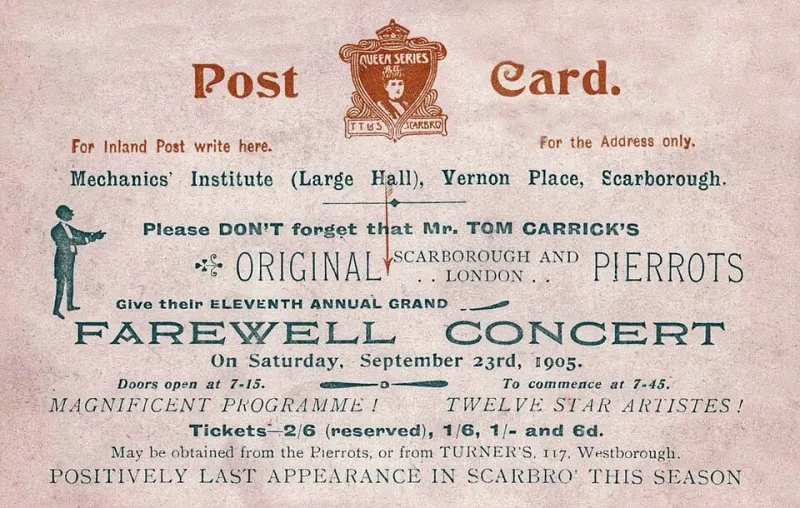
Photo: Publisher: TT&S Queen Series, Scarbro., Public domain, via Wikimedia Commons
There is a particular smell to an old postcard. Dust, faintly sweet paper, and something else — the ghost of a mantelpiece it once stood on. In Cowling, those little rectangles of card have a habit of turning up in house clearances, at the back of drawers, or pressed inside a family Bible. They show the village as somebody once wanted it remembered, and then they tell a second story on the back.
The Card That Started It
My own first Cowling card was a real photographic postcard of the main street, probably taken sometime before the First World War. A trap and horse stand outside a shop, a boy in a flat cap is blurred by movement, and the whole scene is framed by that slightly wonky perspective you get when a photographer sets up a tripod in a hurry. It cost me two pounds at a car boot sale in Skipton. I bought it because of the message on the back: ‘Arrived safe. Tea was lovely. Will write Sunday.’ No name, no address, just a stamp and a postmark from Cowling.
That card set me off. Since then I have looked at dozens — some held by neighbours, some in the local history collection, some spotted online and saved to a folder marked ‘Cowling bits’. They are not grand artefacts. But together they do something a census return cannot: they show the village as a place people posed for, sent to aunts in Bradford, and kept in a shoebox for a hundred years.
What Was Worth Showing
Postcard publishers knew their market. For a village like Cowling, the standard views were the ones that said ‘this is somewhere’: the main street with its shops and narrow pavements, the old school on the hill, the chapels with their Sunday-best fronts, the pubs at the corner, and the moor beyond. Wainman’s Pinnacle often appears as a distant thumb on the skyline, almost an afterthought, but unmistakably Cowling.
Then there are the less obvious cards. A view of the station, maybe with milk churns waiting on the platform. A card of the bridge over the beck. A picture of a Sunday school outing with three rows of hats and a banner that has faded to grey. Publishers like W. H. Smith and local stationers produced these in their thousands, often as much for visitors as for residents. The message was simple: wish you were here. Or, just as often, wish I was there.
Photographic postcards — the ones printed from actual negatives rather than illustrations — are especially useful. You can sometimes date them by the shopfronts, the style of a sign, or the presence of a particular tree that has since grown or gone. They also catch the accidental details: washing on a line, a cart parked at an angle, a dog that nobody meant to include.
The Back Tells the Story
Turn a card over and the history gets personal. Early postcards had space only for the address, with the message squeezed around the picture or written on the front. After 1902, publishers introduced the ‘divided back’, with a column for the address and a space for the message. That single change makes dating much easier: if the back is divided, it is almost certainly Edwardian or later.
But it is the handwriting that pulls you in. I have a card sent from Cowling to a soldier in the First World War, a few lines saying the hay was in and the weather had broken. Nothing sentimental, but the fact it was sent at all says plenty. Another, from the 1950s, shows a couple on a moorland path with a message about a wet week and a good tea shop. The stamp has been carefully peeled off by a collector, which is a small tragedy.
Look for the postmark. A clear one can give you the date and the sending office. Look at the stamp, too — the reign and the design can narrow things down. And read the address: street names change, house numbers appear and disappear, and a card addressed to ‘Miss K. Smith, near the Old School’ is a reminder of how informal the postal service once was in villages like ours.
Messages From the Edge of the Moor
What strikes me most is how ordinary the messages are. People wrote about trains, weather, births, deaths, a new hat, a quarrel with a neighbour. The postcard was the text message of its day — quick, cheap, and not meant to last. That so many did last is a small miracle of attic neglect.
Some cards were sent from Cowling; others were sent to it. A card postmarked from Blackpool or Morecambe, addressed to a house on the moor, is a reminder that the village has always been connected to the wider world. People left, people came back, and the postcard travelled between them.
Bring Yours to the Archive
If you have a shoebox of Cowling postcards, you are sitting on a piece of the village’s story. We would like to build a small community archive — not to take the cards away, but to record them. A photograph of the front and back, a note of any names you recognise, and a rough date if you have one. Even the dullest-looking card can fill a gap.
So next time you are sorting through a drawer, keep an eye out for a card with a Cowling postmark. It might show a street that has changed beyond recognition, or a face you have never seen. Either way, it is a message from the village to itself. And it is still worth reading.