Scars in the Moor: How Cowling’s Little Quarries Built the Village
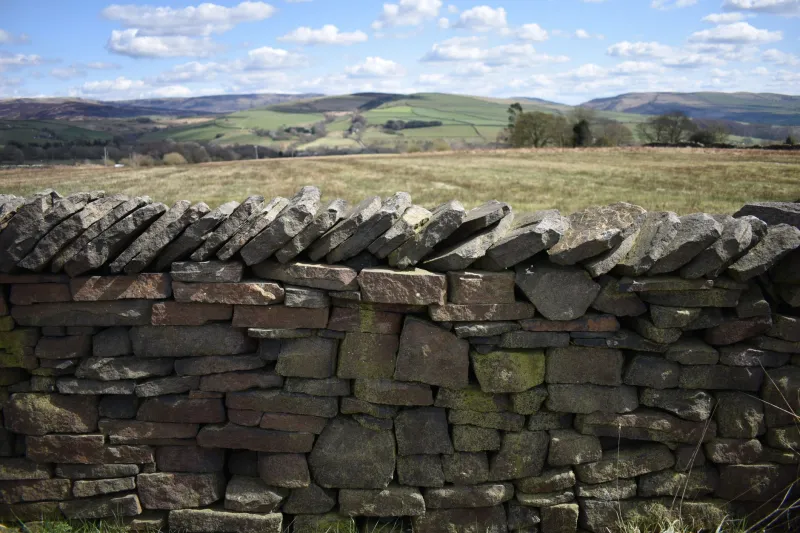
Walk out of Cowling on almost any lane and you will soon meet a wall. It runs ahead of you, dark and weathered, lichened on one side and nettled at the foot. We tend to treat these walls as part of the scenery, as natural as the bracken or the curlews. They are not. Every length of them was built by hand, and much of the stone came from small pits and quarries close enough to the village that a cart could make the journey and be back before dark.
Those little quarries are easy to miss today. Some are no more than a hollow in a field, a rushy dip with a few squared stones lying about. Others show as a low scar on the moor, fringed with hawthorn and bilberry. They do not have the drama of a great industrial quarry, and they were never meant to. They were working places on a domestic scale: a farmer taking stone for a barn, a cottager gathering flags for a floor, a waller needing enough gritstone to repair a boundary after winter.
A landscape written in stone
The geology around Cowling is generous with gritstone, and generosity of that kind shapes a village. Stone was never far away, so it was used for almost everything: field walls, house walls, outbuildings, gateposts, troughs, steps and kerbs. Timber might come from a plantation and slate from far off, but the ordinary stone of the district came from the ordinary ground beneath people’s feet.
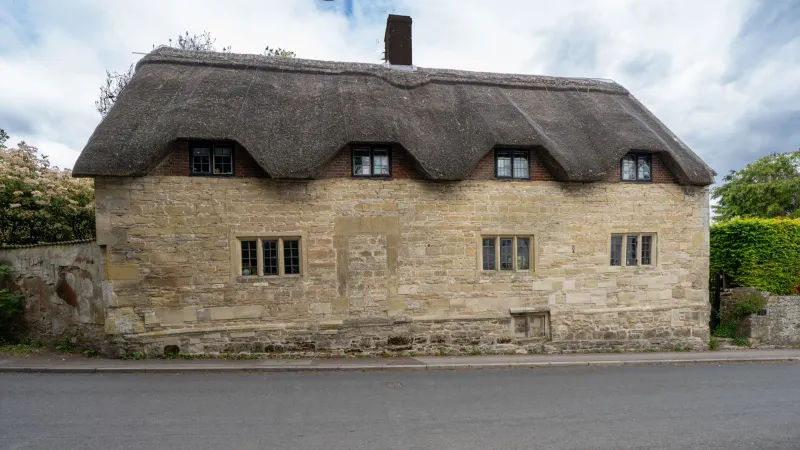
Look at the older cottages in the village and you can often read their origins in the stone. Some show rough, thick blocks with a pitted face. Others have thinner, more regular stones that suggest a different working or a different source. Barns are often plainer still, built for use rather than show, with openings later blocked and walls later heightened. None of this was accidental. A builder chose what was nearest and what would bear the weight, and the little quarries around Cowling supplied both.
The quarryman’s day
Oral memories of the small quarries are thin on the ground now, but what survives has a steady rhythm to it. Men walked out from the village with tools over their shoulders. Some worked alone; others in pairs or small gangs. The work was cold in winter and dusty in summer, and it was rarely more than a few hundred yards from home. That closeness matters. These were not distant industrial sites. They were part of the working landscape, somewhere between the farmyard and the moor.
Stone had to be split, dressed and shifted. Good wallers could make a rough block sit true, but even rough work took judgement. A stone that looked sound on the outside might split badly, and a length of wall built from the wrong stone would soon bulge and fail. Quarrymen knew which beds to follow and which to leave alone. That knowledge was passed on by watching and doing, not by reading.
There were also the small, unglamorous jobs that kept a quarry usable: clearing spoil, keeping a track open, mending a barrow, watching the weather. A wet autumn could stop work as surely as a hard frost. In a village where most people had several ways of earning a living, quarry work fitted around haytime, walling, carting and whatever else the season demanded.
Carts, sledges and the lanes
Getting stone from the quarry to the building site was often harder than getting it out of the ground. The lanes around Cowling are not forgiving. They rise, bend and narrow, and in wet weather they turn to something between mud and a stream. Carts were used where there was room, but smaller loads and sledges had their place on steep ground. Horses and humans did the rest.
This is one reason the little quarries were so local. A quarry five miles away might have better stone, but it cost more to move it. A quarry just beyond the field gate might be awkward and shallow, but it was close. For ordinary farm buildings and boundary walls, close usually won. The result is a landscape where the stone in a wall can often be matched, roughly, to a hollow nearby.
Reading the walls
If you want to find Cowling’s forgotten quarries, start with the walls rather than the map. Look for changes in stone: a stretch of rougher blocks, a corner where the colour shifts, a repair that uses thinner stones than the rest. These changes are not always evidence of a quarry, but they are clues. They remind us that walls were not built once and left alone. They were maintained, patched and rebuilt, often with whatever stone was to hand.
Then look for the ground that supplied it. A small quarry often sits uphill of a wall or building, because stone is easier to move downhill than up. It may be surrounded by self-sown trees and bracken, with a flat floor and a steep back face. Sometimes there is a track leading away, worn into the ground. Sometimes there is nothing but a scatter of stones and a change in the vegetation.
These places deserve a second look. They are not grand monuments, but they are part of the same heritage as the village’s older houses and barns. They record small-scale industry, local skill and the practical business of making a living in a Pennine village.
What remains
Some of the old quarries have been filled in, used for tipping or quietly reclaimed by woodland. Others survive as damp hollows where frogs spawn in spring and foxgloves stand in summer. A few still show clear tool marks on the stone, though these are easily overlooked. None of them are likely to appear on a grand heritage trail, and perhaps that is fitting. They were never intended to be visited. They were places of work.
But they are still worth remembering. The next time you walk past a long field wall outside Cowling, consider where its stone began. Somewhere nearby there is probably a hollow in the hillside, a scar in the moor, a quiet corner where men once split and dressed the stone that now keeps the fields in order. The wall is the monument. The quarry is the memory.
Keeping the memory
Cowling History would like to hear from anyone with memories of the village’s small quarries, or photographs of quarrymen, carts, wallers and the old tracks that served these workings. Even a name or a half-remembered location helps. The past is often preserved in stone, but it is kept alive by people who are willing to point it out.