Before the Tanker: How Cowling’s Farms Sent Milk Down the Lane
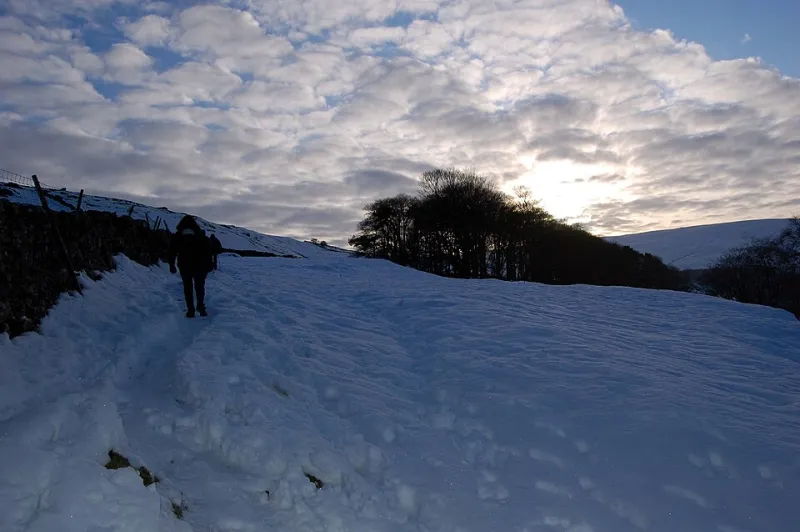
Photo: Jean L., CC BY 2.0, via Wikimedia Commons
There are sounds that belong to a place even after they have gone. For a generation in Cowling, one of them was the clang of a metal churn being set down on a concrete slab at the end of a farm track. It was not a dramatic noise. It was a practical one: lid on, handle checked, stand back, wait for the lorry. Yet for anyone who lived along the lane, it was also a kind of clock. The churn at the gate meant the day had started.
Before bulk tanks, before refrigerated tankers and long before milk arrived in plastic bottles and cartons, Cowling’s small dairy farms sent their milk out in churns. These shining cylinders, often aluminium and sometimes painted with a farm’s initials or a number, were left at an agreed spot for collection. The spots were rarely grand. A concrete slab beside a gate, a low stone platform, a widening in the lane, a wooden stand that had seen better days. Taken together, they formed a quiet network across the parish — a map of milk that most people today would not recognise.
A slab, a churn and a daily appointment
The milk stand was never meant to be beautiful. It was meant to be useful. It had to be reachable by lorry, clear of the worst mud, and close enough to the farm that a full churn could be carried or barrowed to it without too much trouble. Some stands were little more than a flagstone. Others were concrete platforms built up beside a wall, with just enough height to save the driver’s back. A few had a simple frame or shelter, though most were open to whatever the weather decided to do.
In winter, the churns would be frosty before dawn. In summer, farmers tried to keep them in the shade for as long as possible. The lids had to be secure, the handles sound, the numbers legible. A churn was not just a container. It was a small piece of farm equipment that had to be cleaned, dried, handled and returned. The empty churns came back on the same round, clattering in the back of the lorry, ready to be filled again.
For villagers, the stands became landmarks without ever being named on a map. Directions might be given as ‘just past t’ milk stand’ or ‘opposite where they leave churns’. Children knew them as places to loiter on the way to school. Dog walkers knew them as fixed points on a familiar route. And farmers knew them as the first appointment of the working day.
The round that ran before breakfast
The milk round began early. In many places it had to. Milk was a perishable product, and the churns needed to be gathered and moved on before the day grew warm. The driver and his mate — and it was usually a physical job, lifting and shifting heavy churns — worked their way from farm to farm along a route that had been refined over years. Some lanes were narrow. Some gateways were awkward. Some farms had a dog that remembered the lorry before the driver did.
There was a rhythm to it. Pull up, lift the full churn, check the lid, record the quantity, load it, leave the empty. Exchange a few words if the farmer was about. Move on. In bad weather the round could be slow and cold; in good weather it could be almost pleasant. But it was never casual. Milk had to be accounted for. Churns had to be kept clean. Records had to be kept. The small dairy economy of a place like Cowling depended on a hundred small acts of reliability.
For some residents, the milk stand was also a brief social point. Not a meeting place in any organised sense, but a spot where two farmers might pass the time while waiting for the lorry, or where a neighbour might stop to ask after a family. In a scattered parish, those few minutes at the gate could matter. They were part of the fabric of village life, as ordinary and as necessary as the milk itself.
Small farms, big changes
Cowling’s farms were never vast by the standards of the great arable estates. They were smallholdings and family farms, often with a few cows, a few fields and a great deal of hard work. Milk was one of the ways such farms made a living. It went out into a wider system — to dairies, depots and processors — but it began locally, at a gate, in a churn.
That system changed steadily in the second half of the twentieth century. The Milk Marketing Board, established in the 1930s, had already reshaped how milk was sold and regulated. Testing, pasteurisation and stricter hygiene rules raised standards and costs. Bulk tanks arrived on farms, allowing milk to be stored and collected in larger quantities. Refrigerated tankers replaced the old churn rounds. Fewer farms kept dairy herds. The economics of small-scale milk production became harder, and the daily collection from a roadside stand began to look old-fashioned.
By the 1970s and 1980s, many of the old stands had fallen out of use. Some were removed. Some were swallowed by hedges. Some simply remained, a concrete slab with nothing to do. The churns themselves were sold, scrapped or repurposed. In later years, an old milk churn might turn up as a planter, a log bin or a piece of garden ornament, its original purpose half-forgotten. The clang at the gate had become a memory.
The stands that stayed behind
If you walk Cowling’s lanes today, you may still pass places that look like nothing much at all. A patch of concrete at a field gate. A low stone ledge beside a wall. A widening where a lorry could once have pulled in. These small survivals are easy to miss, but they are part of the village’s working history. They tell us how milk moved before the tanker came, and how ordinary routines left their mark on the landscape.
The old milk stands also remind us of the people behind the pints. The farmer up before light. The driver with cold hands and a clipboard. The family who washed and scalded churns at the yard tap. The neighbour who knew the round’s timetable better than the bus timetable. These were not famous people, but they kept a village fed and a local economy turning.
Cowling History would like to hear from anyone who remembers the milk rounds. Do you know where a stand once stood? Was there a churn in your family’s yard, or a lorry that came so early you barely noticed it? Photographs, memories and rough sketches of vanished stands are all welcome. The churn at the gate may have gone, but the story of how Cowling’s milk went down the lane is still worth keeping.