The Stone That Watches Cowling: New Light on Wainman's Pinnacle
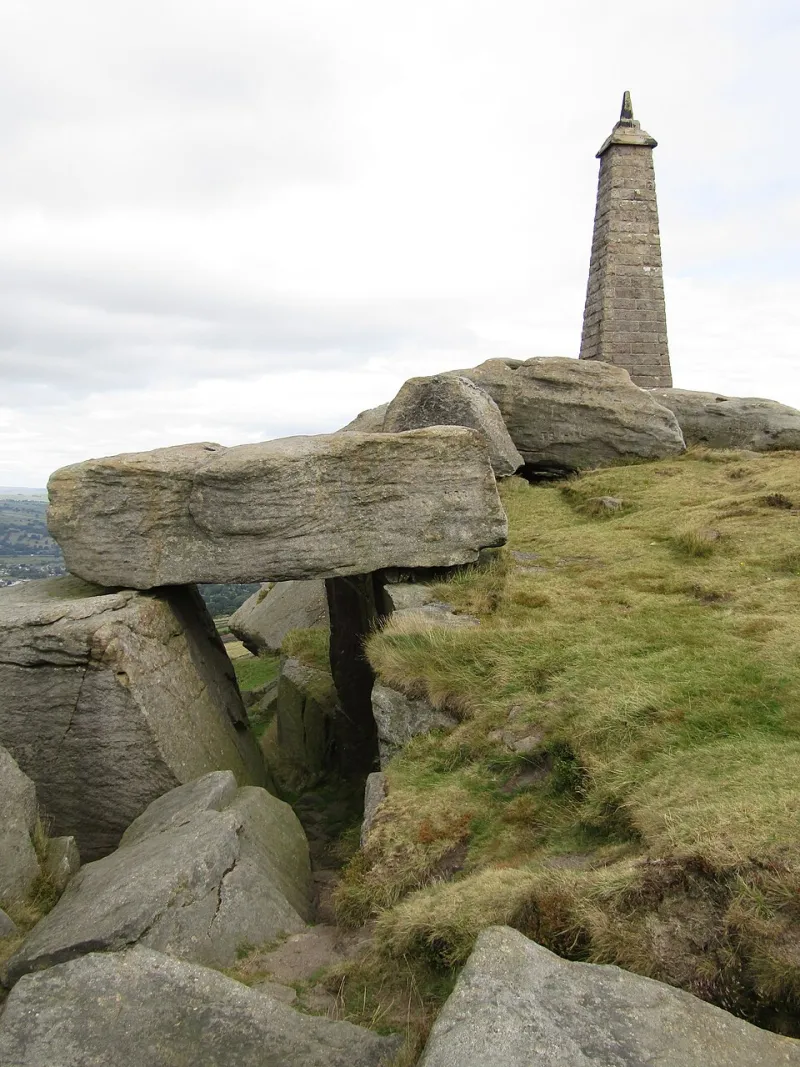
Photo: Colin Smith , CC BY-SA 2.0, via Wikimedia Commons
On a clear afternoon, you can pick out Wainman's Pinnacle from half a dozen places in Cowling. It stands on Earl Crag like a finger pointing at the sky, and for generations it has been the village's most recognisable silhouette. But ask a dozen people why it is there and you will get a dozen answers. That is not a failure of local memory. It is a reminder that landmarks like this collect stories the way drystone walls collect moss.
A landmark with more than one story
Most local accounts agree on the broad outline: the pinnacle was raised in the late 1890s, and it is linked to the Wainman family of Carr Head. Beyond that, the details begin to soften. One tradition says it was built as a memorial to a son; another ties it to Queen Victoria's Diamond Jubilee of 1897; a third calls it a folly, pure and simple, put up by a wealthy family with an eye for a view. The truth may be a mixture of all three. Victorian memorials were rarely just one thing, and a structure that looks plain from a distance can carry several layers of meaning close up.
What matters for Cowling is not only what the pinnacle was meant to be, but what it became. It is a waymark for walkers, a backdrop for family photographs, a shape on the horizon that tells you where you are. Ask anyone who has walked home across the moor in fading light and they will tell you that the pinnacle does more than decorate the view. It orients you. It says: Cowling is down there.
Reading the maps and the photographs
Old Ordnance Survey maps mark the pinnacle plainly, and early 20th-century postcards show walkers and day-trippers making the climb to Earl Crag. In those images the monument often appears alongside Lund's Tower, the other great stone marker on the crag. The two are frequently paired in walkers' accounts, and together they give the ridge its distinctive character. One is a tower, the other a pinnacle; both have been claimed by local legend and both have been cared for by people who regard the crag as part of the village's common inheritance.
Photographs are useful because they show change as well as continuity. Fashions in walking gear come and go. The stone stays. In family albums and in the Cowling History archive, the pinnacle turns up in the background of picnics, school outings and informal snaps. It is rarely the subject, which is precisely why it is revealing. It is simply there, part of the furniture of village life.
The legends that cling to the crag
Every monument of this kind attracts stories, and Wainman's Pinnacle has attracted its share. Children were once told it was a giant's finger. Others have said it was a beacon point, a lookout, or a memorial to a lover. One persistent local yarn insists it was built to give work to local men during a hard winter. None of these tales can be proved from the stone itself, and that is part of their charm. They are the kind of stories communities tell to make a landmark their own.
It is worth being careful with legends. They can easily harden into fact if they are repeated often enough. The better approach is to enjoy them as memories and oral history, while keeping an eye on what the documents can actually support. The pinnacle is interesting enough without turning it into a mystery novel. Its real story is a quieter one about family, remembrance, land and the way a structure on a hillside becomes part of a village's identity.
A landmark that needs looking after
Like any exposed structure, the pinnacle has taken a battering from weather over the years. Repairs, footpath erosion and the sheer number of boots on the crag have all been concerns at various times. What stands out in local accounts is the steady, unglamorous care: farmers, walkers, parish councillors and volunteers keeping an eye on the path, reporting damage, and making sure the monument is not loved to pieces.
That is the part of the story that often goes unrecorded. We know the names of the families who paid for great stone monuments. We know much less about the people who cleared a drain, repaired a stile or asked visitors to stick to the path. If you have photographs, letters or memories of the pinnacle, the Cowling History archive would like to hear from you. The stone may watch over Cowling, but it is the people who keep its story alive.